
Tarangire National Park is the sixth largest national park in Tanzania after Ruaha, Serengeti, Mikumi, Katavi and Mkomazi. The national park is located in Manyara Region. The name of the park originates from the Tarangire river that crosses through the park, being the only source of water for wild animals during dry seasons. During the dry season thousands of animals migrate to the Tarangire National Park from Manyara National Park.
It lies a little distance to the south east of Lake Manyara and covers an area of approximately 2,850 square kilometers(1,100 square miles.) The landscape and vegetation is incredibly diverse with a mix that is not found anywhere else in the northern safari circuit. The hilly landscape is dotted with vast numbers of Baobab trees, dense bush and high grasses.
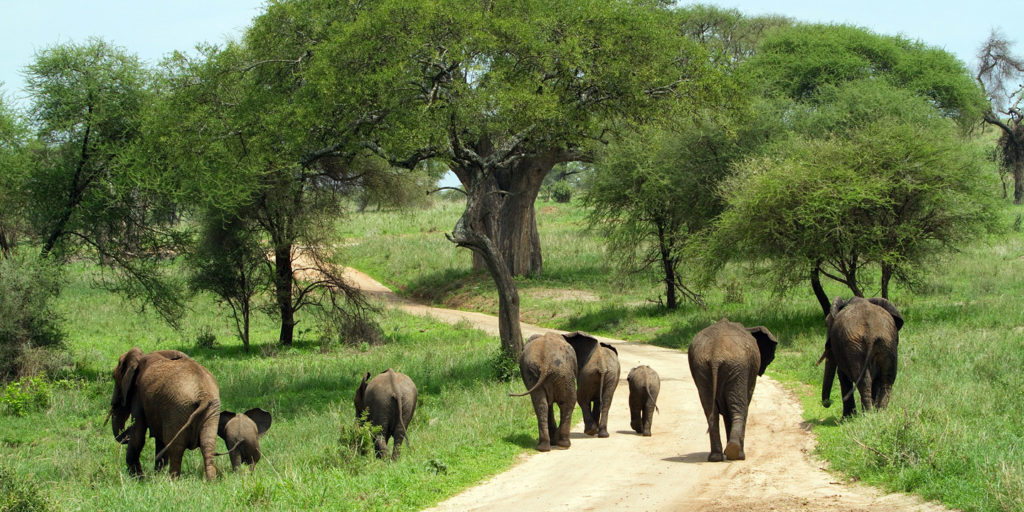 The park is famous for its huge number of elephants, baobab trees and tree climbing lions. Visitors to the park can expect to see any number of residential zebras and wildebeests in addition to the less common animals. Other common animals include waterbuck, giraffe, and olive baboons.
Home to more than 550 species, the park is a haven for bird enthusiasts who can expect so see dozens of species even in the dry season. The swamps are the focus of the largest selection of breeding birds anywhere in the world. yellow-collared lovebirds are a common bird sighting in the trees along the Tarangire River.
The park is also famous for the termite mounds that dot the landscape. Those that have been abandoned are often seen to be home to dwarf mongoose.
In 2015, a giraffe that is white due to leucism was spotted in the park.
About Tarangire National Park
Size: 2850 sq km (1,096 sq miles).
Location: 118 km (75 miles) southwest of Arusha.
Getting there
Easy drive from Arusha or Lake Manyara following a surfaced road to within 7km (four miles) of the main entrance gate; can continue on to Ngorongoro Crater and the Serengeti.
Charter flights from Arusha and the Serengeti.
What to do
Guided walking safaris.
Day trips to Maasai and Barabaig villages, as well as to the hundreds of ancient rock paintings in the vicinity of Kolo on the Dodoma Road.
When to go
Year round but dry season (June – September) for sheer numbers of animals.